Network Rail faces a battle with its staff over proposals to close nearly all Britain’s 800 signal boxes and replace them with air traffic control style computerised centres.
NR held talks on the plans this week with unions representing its 5,000 signallers. The company refused to confirm claims by the Rail, Maritime and Transport Union that the changes would reduce the number of signal staff, which the union puts at 6,000, to 2,000. The changes are intended to boost punctuality and save £250m annually. Full article in FT
It is not clear from the article whether this refers to the introduction of the European Train Management System (ERTMS), which still has a long way to be developed before it can be said to be beyond the experimental stage. Whilst I have nothing against the introduction of new technology, I would question whether it is sufficiently robust to withstand the kind of things that can happen in the long run, such as extreme weather, solar flares and other unusual and potentially damaging events.
About thirty years ago a snowstorm brought down ancient signalling equipment on the Exeter line west of Basingstoke. The service was kept going using a makeshift arrangement using the public telephone system. Present day GPS systems seem unable to cope with things like train announcements when reception is bad - in tunnels and cuttings, for instance - and in some places they are consistently given out incorrectly. So there not only is there a lot more testing and refinement to be done before such a system is up and running - there is the potential here for pouring a few billion pounds into a black hole.
The union response is predictable - that just shows the persistent influence of job creationist theory. There is plenty of work to be done. The reasons why it is not done and that the unions' members face the prospect of unemployment and will not share directly in the benefits are questions that those who work in the trade unions' policy departments would do well to start asking.
Changes signal death of old technology


15 Jul 2011
Thameslink and the Derby job losses
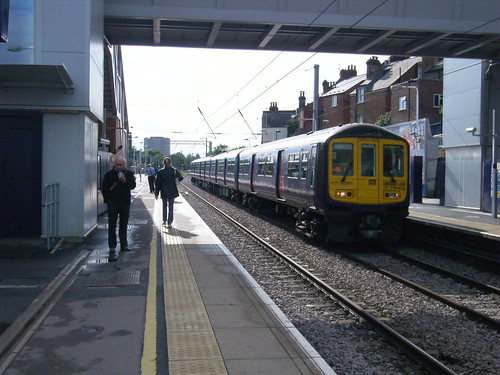
I am not an advocate of Buying British in principle, but Derby would almost certainly have got the Thameslink train order if there had been some rational thinking about Thameslink itself. There is no conceivable train that can operate the route satisfactorily as it comprises two inter-urban routes, two airport links and an inner city metro all in one.
Thameslink should have been cut back to operate within the area of the Greater London Authority. Anyone who has used the service regularly and thought about it must realise this. A problem at, say, Brighton will result, a couple of hours later, in disruption at Bedford, and vice versa. This is not unusual as both the Brighton and Midland main lines carry dense traffic. It would have been better to cut back the route and transfer it to London Overground which is a similar type of service. The trains could then have been a further build of Bombardier class 379 Electrostars.
For the long distance routes a further build of class 377 Electrostars would have done the job perfectly well. A small additional fleet of Electrostars has already been running on Thameslink for the past couple of years. These are fully compatible with Southern's existing fleet so the operators can help each other out when things go wrong. This results in a bit of mixing and borrowing as required.
The introduction of Siemens stock will preclude this as it will almost certainly not be operationally compatible with the Electrostar fleet with which it will share the tracks.
Had the DfT made this a requirement as it most obviously should have been, it is most improbable that the order would gone anywhere else than to Derby. However good the Siemens bid may have been, it has not resulted in a best buy.
I blame the civil servants at the DfT.
5 Jul 2011
Bombardier announces job losses
Bombardier announced today the loss of over 1,400 jobs at its Litchurch Lane factory in Derby. This follows the award of the £3 billion train order to the German company Siemens. Diana Holland, assistant general secretary of the trade union Unite, has written to Philip Hammond and Vince Cable, demanding an urgent meeting.
Of course, without detailed inside knowledge one cannot possibly comment on the particular situation inside the Derby plant, but the tendency within the UK, in contrast to industry in countries like Germany, and Japan, is for management to keep a certain distance from the people on the factory floor, issuing orders from on high and failing to put sufficient value on the knowledge held by those in the front line. It is largely a consequence of the British class system. I wonder if the Bombardier factory is a shining exception?
Of course, without detailed inside knowledge one cannot possibly comment on the particular situation inside the Derby plant, but the tendency within the UK, in contrast to industry in countries like Germany, and Japan, is for management to keep a certain distance from the people on the factory floor, issuing orders from on high and failing to put sufficient value on the knowledge held by those in the front line. It is largely a consequence of the British class system. I wonder if the Bombardier factory is a shining exception?
3 Jul 2011
An era ends
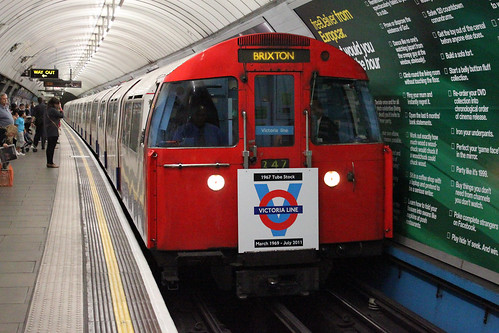
1967 Tube Stock at Pimlico, originally uploaded by bowroaduk.
After 43 years, the end of an era: the 17.10 train from Seven Sisters to Brixton, the last 1967 Tube stock in passenger service, 30th June 2011. The design was the product of Design Research Unit, the company headed by Mischa Black, professor of industrial design at the Royal College of Art.
Sadly, these days, design has been degraded to become very largely, and little more than, an adjunct of marketing, though the old tradition lives on in Scandinavia. So this example of honest functional design deserves to be celebrated.
Boris derails Cameron's 'perverse' £34billion high-speed link
According to an article in the Daily Telegraph, 'The future of the planned High Speed 2 rail link has been thrown into fresh doubt after Boris Johnson dubbed the project "perverse" and "inadequate" and said he "cannot support" it.'
I don't think anything Boris Johnson says is going to be decisive in this but he is a big and influential gun. The trouble with the Anti-HS2 lobby, however, is that too much of it consists of Nimbys and elements from the roads lobby such as the RAC.
The pro-rail lobby needs to speak up for a sound alternative strategy of investment in rail. The country could end up with nothing at all.
I don't think anything Boris Johnson says is going to be decisive in this but he is a big and influential gun. The trouble with the Anti-HS2 lobby, however, is that too much of it consists of Nimbys and elements from the roads lobby such as the RAC.
The pro-rail lobby needs to speak up for a sound alternative strategy of investment in rail. The country could end up with nothing at all.
25 Jun 2011
Station dwell times

Station dwell times can have a big effect on the overall performance of a railway, especially a busy commuter routes. The old slam door trains had doors spaced two metres apart, which made for fast boarding and alighting, and passengers used the open doors to provide support over the gap between the platform and the train.
Much of Britain's railway system was built when railway carriages were under ten metres long, which meant that there was never much of a gap even at sharply curved platforms. In combination with the high platforms that were standard in Britain, getting on and off trains was easy. But nowadays, carriages are twenty metres long or more, which means there can be a significant gap. Worse still, the tracks are now more sharply tilted on curves to allow for higher speeds.
This leads to the situation here at Clapham Junction, where there is a huge gap between the platform and the train. Apart from being a danger, passengers take extra care and extra time to get on and off the train, which extends the station dwell time.
Attempts have been made to help the situation. Modern trains have lower floors, and the doors are as close to the bogie centres as possible, given the 1:3/2:3 layout, as in the Electrostar train above, which is also supposed to improve station dwell time. Matters are no better with the mark 3 stock with end doors, but in that case the problem occurs at convex platform faces rather than concave ones as in the picture.
Never mind the gap
We really are at the point where new stock should be fitted with retractable steps, so that there is no gap to mind. It would also be possible to provide retractable handrails at the doorways to facilitate boarding and alighting. Retractable steps are a standard feature in new trains on the continent
These items would of course come at a cost, but the benefits of safety and reduced station dwell time would surely be worth it. With an ageing population, will soon be a necessity if the railway is to be accessible to as many people as reasonably practicable.
21 Jun 2011
HS2 Inquiry reponses published
The responses to the Inquiry by the Select Committee of the House of Commons can be viewed here.
Subscribe to:
Posts (Atom)